 English (UK)
  Deutsch
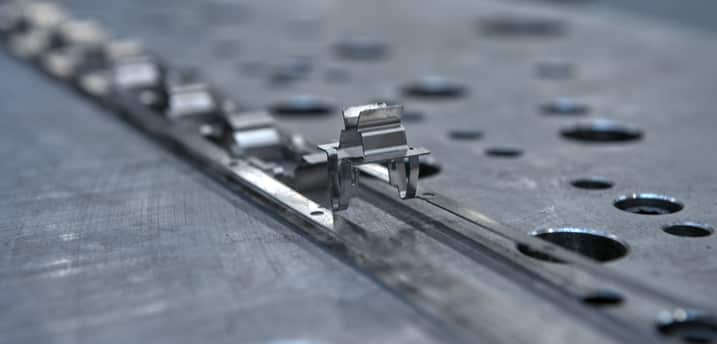
In order to manufacture technical springs in their almost unmanageable variety of applications in a purpose-optimised manner and always using state-of-the-art technology, it is necessary to be well versed in the procurement of optimal materials and components as well as in all manufacturing processes. In order to meet the highest quality standards, the laser cutting, punching, forming and assembly of technical springs requires not only the use of state-of-the-art technology but also the associated specialist expertise of our employees.
Form follows function
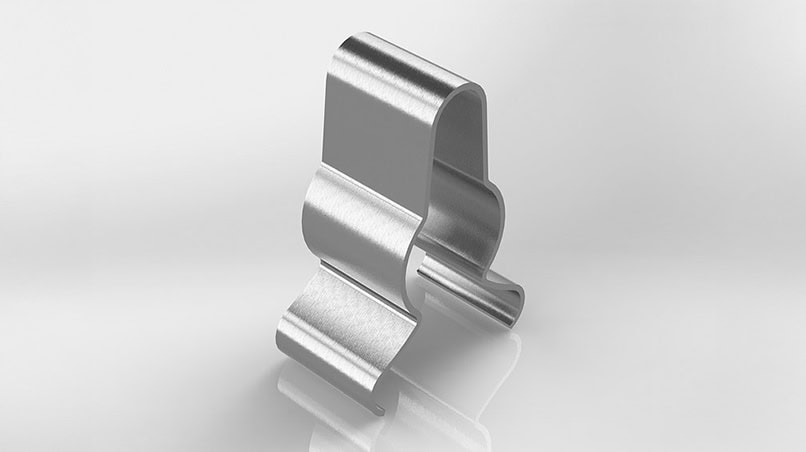
The well-known phrase from the doctrine of good design applies in particular to the highly diversified range of applications for technical springs. Whether moulded spring, flat spring, spring clip or spring clip: The starting point for design considerations for a customised solution - whether highly complex or very simple - is always the required functionality. It must fit perfectly into the surrounding geometry of components. The exciting question here is in which form the spring achieves the highest efficiency value. Sustainability and ecology also play a role in the context of the overall product or the overall machinery in which the spring operates. The shape therefore "follows" more criteria than just its technical function.
Moulded springs are demanding
The production of individual moulded springs is complex. Often complicated shapes, such as those used in mechanical engineering, precision engineering, electrical engineering and medical technology, do not allow for simple calculation and design. In this respect, technical expertise and up-to-date calculation methods are required to ensure that the appropriate manufacturing processes are subsequently used. It is advisable for clients to order detailed documentation of all production factors, which enables them to draw on the knowledge gained and save time in subsequent designs. The more demanding the requirements, the more effective the documentation will be in subsequent processes.
Spring moulds know no limits
As straightforward as the manufacturing processes for technical springs are in principle, their design is limitless. As a rule, pure springs are initially Punching, bending and laser cutting processes which then lead to forming by bending, embossing, edging or deep drawing in one or more further steps. This range of technical moulding processes can be used to create almost countless products that combine maximum functionality in the smallest of spaces. The Surface treatments specialises the spring for its particular purpose.
Trowalising, vibratory grinding, phosphating, burnishing, galvanising and painting are all processes that should be part of the toolkit of every manufacturer of technical springs.
The key to the optimum mould spring
Expertise in all areas of the overall production package determines the efficiency and sustainability of the individual technical spring. At Schaaf, you can be on the safe side if you want to find the concentrated knowledge of materials and substances as well as the most diverse manufacturing processes in-house. Of course, this also implies the availability of state-of-the-art machinery, with which even the supposedly unsolvable problem is confronted with a product that contains a customised, sustainable and economically convincing solution.