 English (UK)
  Deutsch
Dozens of different functions that are assigned to technical springs come to mind as a matter of course. Holding, connecting, clamping, fastening, closing, securing, latching or contacting are the main functions required of them. But what is the engineering definition of technical springs and how do they differ? We explain.
Definition of technical springs
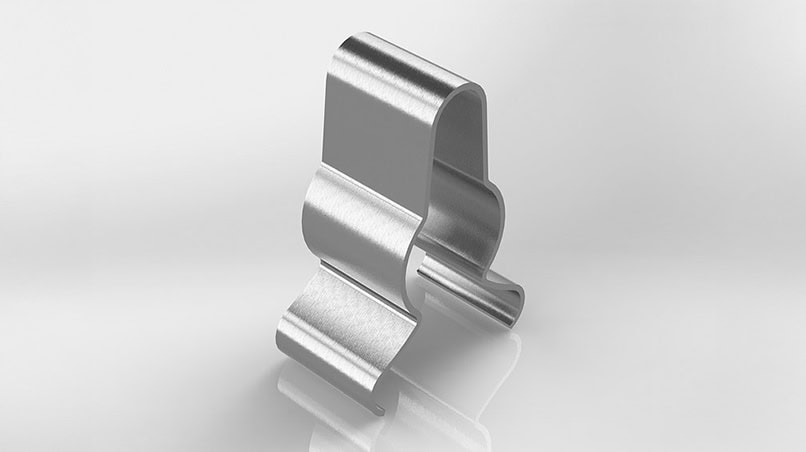
A spring is a technical component made of spring steel that can deform elastically. Under load, it yields and absorbs force, which it releases again when it relaxes and returns to its original shape. The materials from which technical springs are made are primarily spring steel sheet, spring steel strip and spring steel wire. Their designation is often determined by their external appearance: Spring clips, moulded springs, strip springs, flat springs or spring clips.
Formulas of a technical spring
In order to manufacture technical springs with sustainable functionality, a very precise Spring calculation take place. In addition to their shape and the material used, technical springs are defined by the spring constant and the spring characteristic curve. The spring constant describes the increase in force in relation to the path or angle of rotation, while the spring characteristic curve represents the progression of a spring constant. This is usually linear, i.e. the force increases evenly with increasing deformation of the spring. This is referred to as a progressive characteristic curve. This contrasts with the degressive characteristic curve with its uniform decrease in force. There are also combined spring characteristics in which the force properties change.
Where are technical springs used?
Almost all applications that use technical springs are based on a basic function: As elastic components, technical springs yield under load and return to their original shape when the load is released. This basic function is used, for example, to open/close switching contacts or to move parts of a machine. If they are preloaded, they are used as drive energy or as a restoring force, for example in switches. They are also used as a non-positive connection where kinetic energy is converted into potential energy.
The "most" spring types
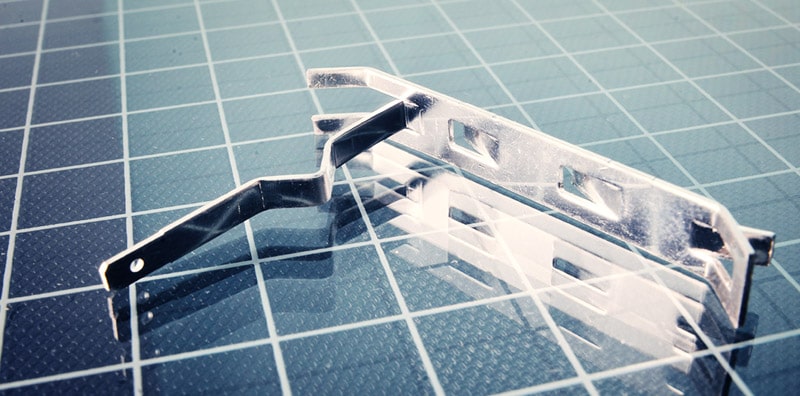
Flat springs in particular are frequently found in contact systems of electrical switches. They are usually installed preloaded as contact springs. In contrast, curved flat springs and moulded springs have an almost limitless range of applications. While a curved flat spring is stamped and simultaneously shaped in a single operation using an automatic stamping and bending machine, a moulded spring is first cut out of sheet spring steel using a laser cutter and then shaped into the desired form by subsequent forming. Spring clips, which are also known as spring clips, pipe clips or Clamping springs are produced in one or two operations, depending on the application. As a rule, they are responsible for a force-fit connection. Wherever something needs to be fixed, locked, adjusted or engaged and Brackets without screws spring clips are the first choice.
From the basic shape to the speciality
Take the knowledge behind the basic facts mentioned above, develop it continuously in line with the rapidly evolving technological requirements and enrich it with decades of expertise gained from countless special orders: The result is a top address for technical springs that produces a customised and sustainable solution for your task, down to the last detail: Schaaf.